Subscriber Onboarding · Growth · 0 → 1
In-Product Sales Connect
"Talk to a human" built into onboarding.
- Summary:
- The onboarding team was facing the same business problem behind several Q2 initiatives: negative net adds and softness in new-unit acquisition. Longer-term, product-led onboarding improvements were already in motion, but they wouldn't land fast enough to change the quarter. This project asked a more immediate question: if human touch already converts better than pure self-serve onboarding, how might the product connect the right new customers to sales at the moment they need help most? The answer became In-Product Sales Connect, a human-help layer built into self-onboarding.
- Design process:
- Product-led onboarding research → the SMB Core Playbook on how reps work a trial → lead-routing routing-latency finding → design lock and a staged A/B launch.
- Solution scope:
- Direct AP/AR trial signups (SMB). The Sales Connect offer placed in two moments — the signup flow and the Get Started page. Lower mid-market and the Accountant Channel were planned future expansions.
- Research:
- ~12 moderated customer interviews, dozens of recorded sales discovery calls, team review.
- Design question:
- Whether an in-product path to a human lifts connect rates and trial conversion without flooding the sales and implementation teams with low-intent leads — via a phased experiment behind a feature flag with holdouts.
- Team:
- 1 product manager, 1 product designer, 1 researcher, 1 content designer, 2 engineers.
01Context & problem
The platform was seeing softness in net-new unit acquisition, while new direct AP trial users often needed clear, fast guidance during onboarding and were unsure which setup steps to take first.
The business case for human connection was already strong. Customers who didn't connect with a person churned at 1.5–2× the rate of those who did. M3 retention for customers onboarded with human assistance sits at 90% while only 65% for customers without assistance. At the same time, the Sales team already had a mature operating model for converting trial users through fast response, discovery, demo, and welcome sessions.
However, self-service onboarding lacks a bridge from "I just signed up and I'm not sure what to do" to "I can talk to a product expert now." That became the design challenge: create a human-help layer inside self-onboarding that would feel useful, timely, and trustworthy without turning the product into a sales trap.
02Three ways to find out why
Talk to customers
Sit in 12 moderated trial user interviews, synthesized independently
Sales calls
Listened to dozens of recorded sales calls
Cross-functional workshop
Organized and led a 15 people working session to create onboarding flow concepts
We paired moderated interviews with recently signed-up customers and dozens of recorded sales qualification and discovery calls. The synthesis showed that new AP/AR customers often had real business pain and strong intent, but were missing clarity on how the platform worked, how it would fit into their workflow, and what to do first once they entered the product.
One insight mattered especially for this project: customers were often convinced by the platform when a salesperson demonstrated the right workflow in context. Those demos were the "aha" moments that helped customers see why the platform was a good fit — especially around approval workflows, bill intake, and secure payments. That made the opportunity clear: if customers were already seeking confidence, structure, and fast answers, then an in-product path to a person should be part of onboarding.
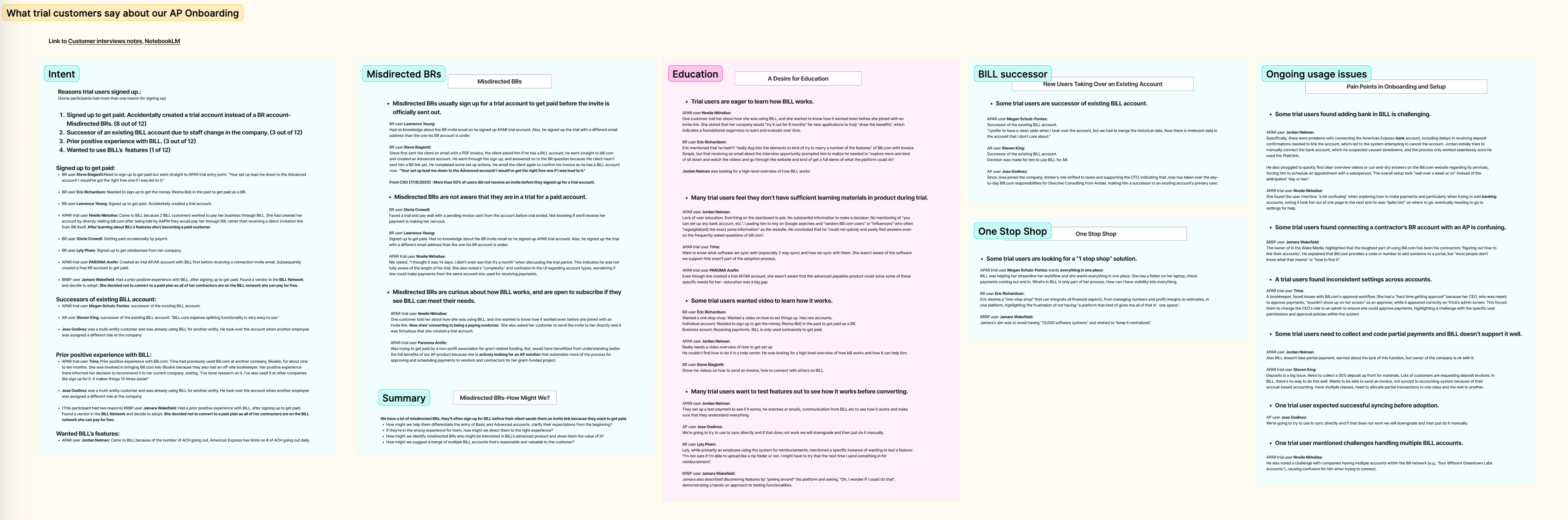
"Having access to a real person will make or break my decision. No AI chatbot."
One participant mentioned that even though she created a trial account, she wasn't aware that the advanced payables product could solve these specific needs for her — education was a big gap.
"[How do I] see transactions as individual line items? How does it save me money and time? I wish someone can explain it to me."
03Design iterations
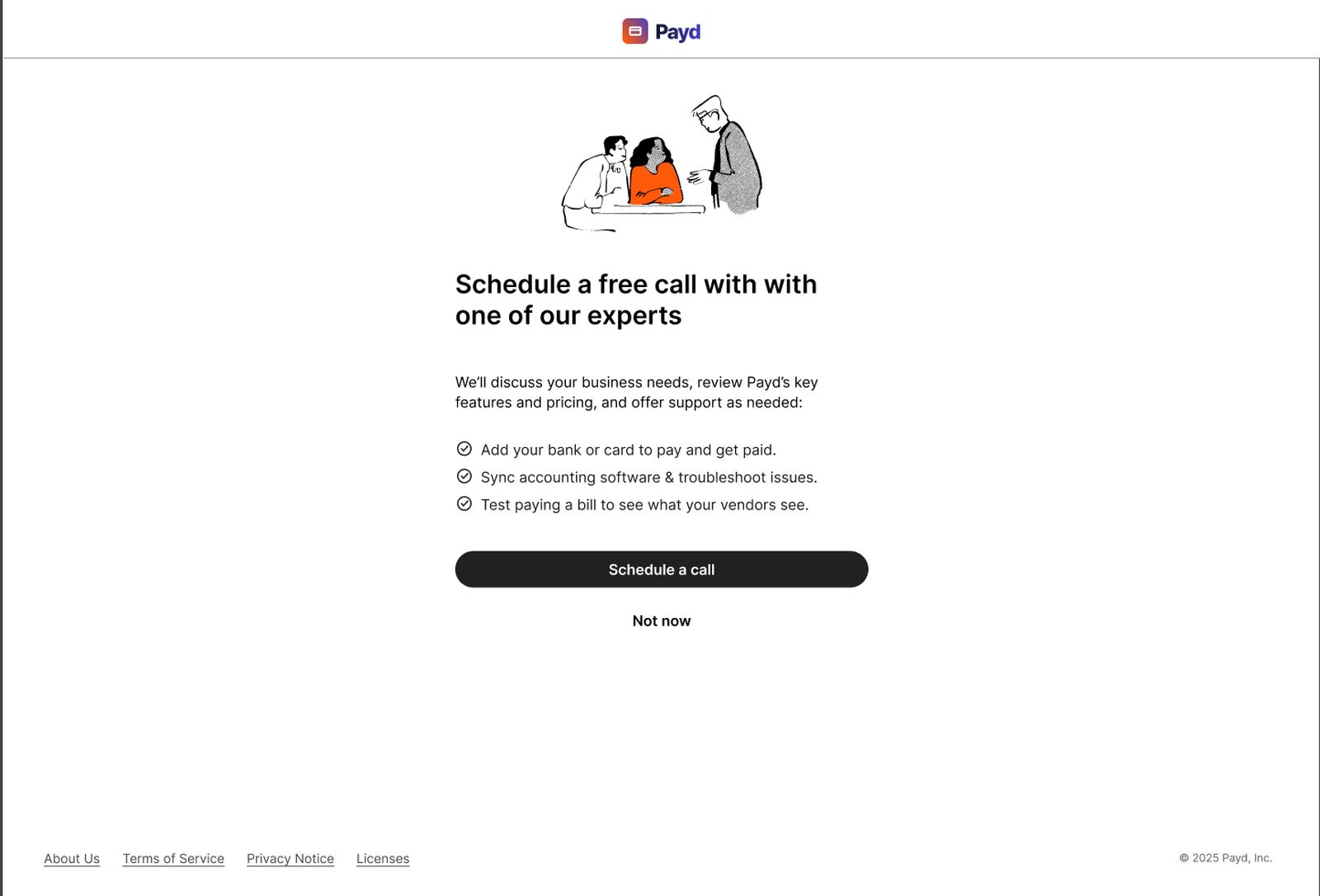
Concept V1 adds a new “Schedule a free call” step after sign up is completed. It paves a common path used in many other products. See below.
Prototype is loading...
Concept V2 iterated on the booking step, with 3 variations. Tesler's Law states that when you simplify too much, you transfer some complexities to the user. Therefore, instead of asking customers to give a definite answer and commit right away, showing them concrete time slots may help with easier decision-making. See below.
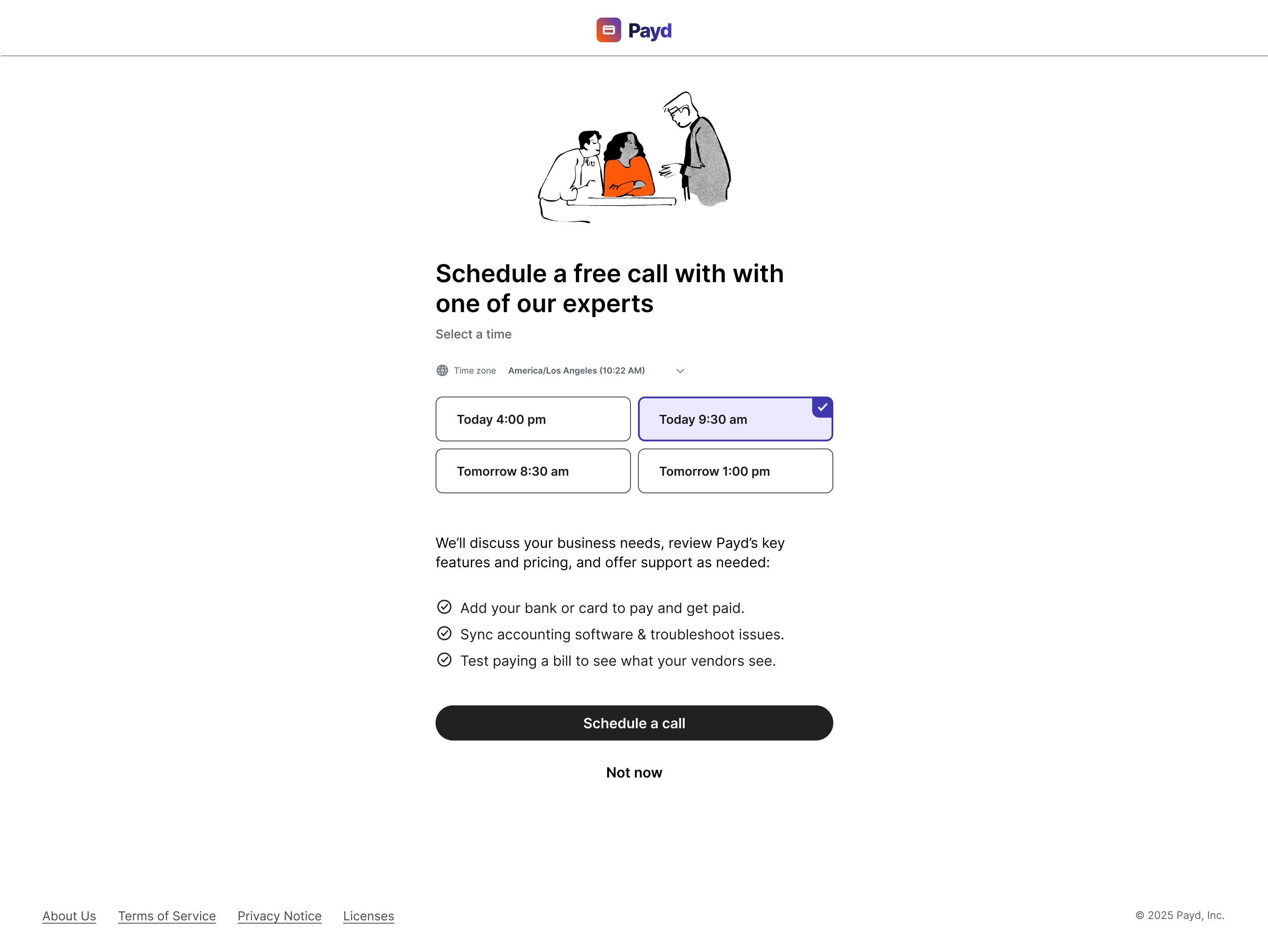
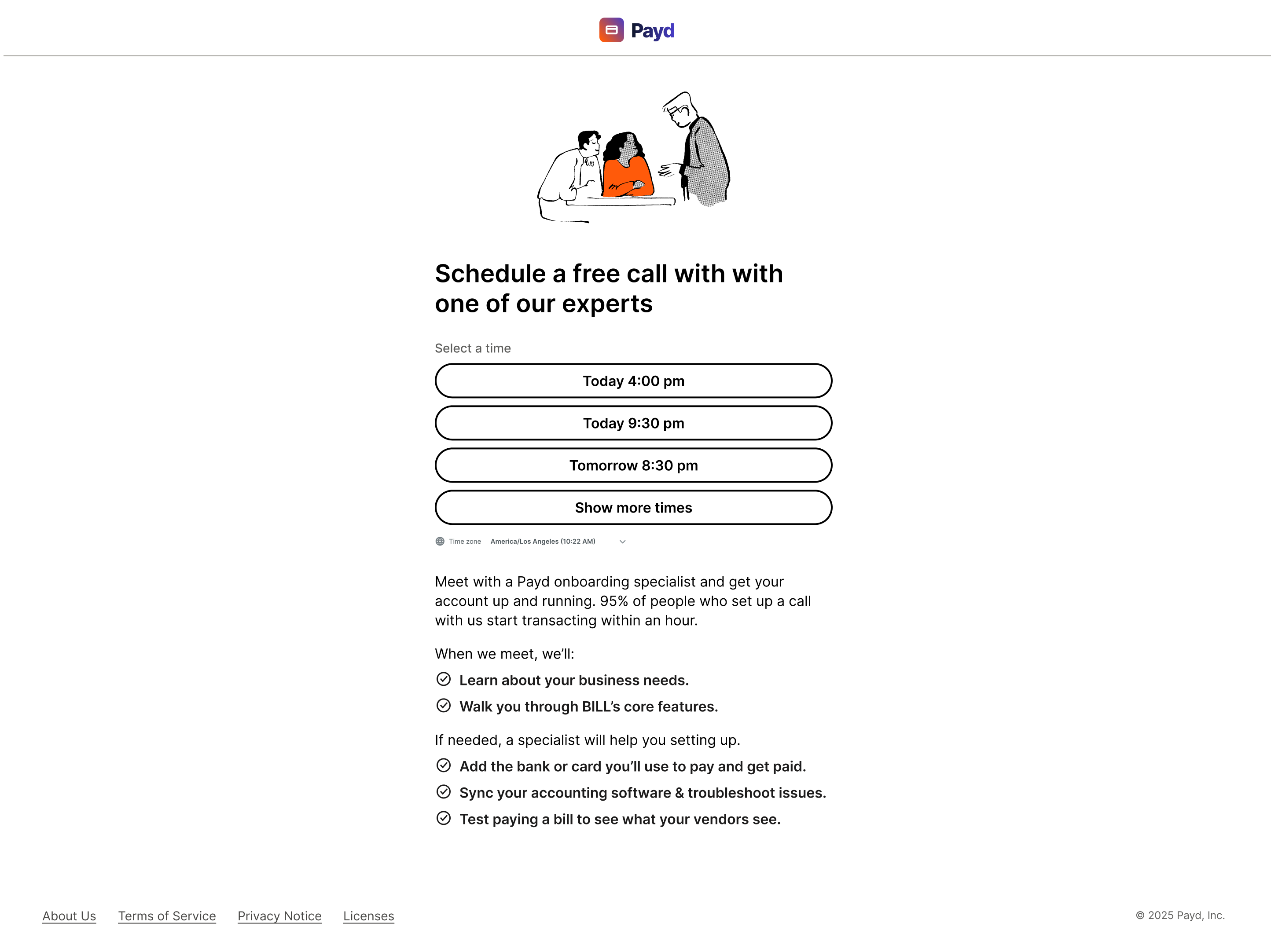
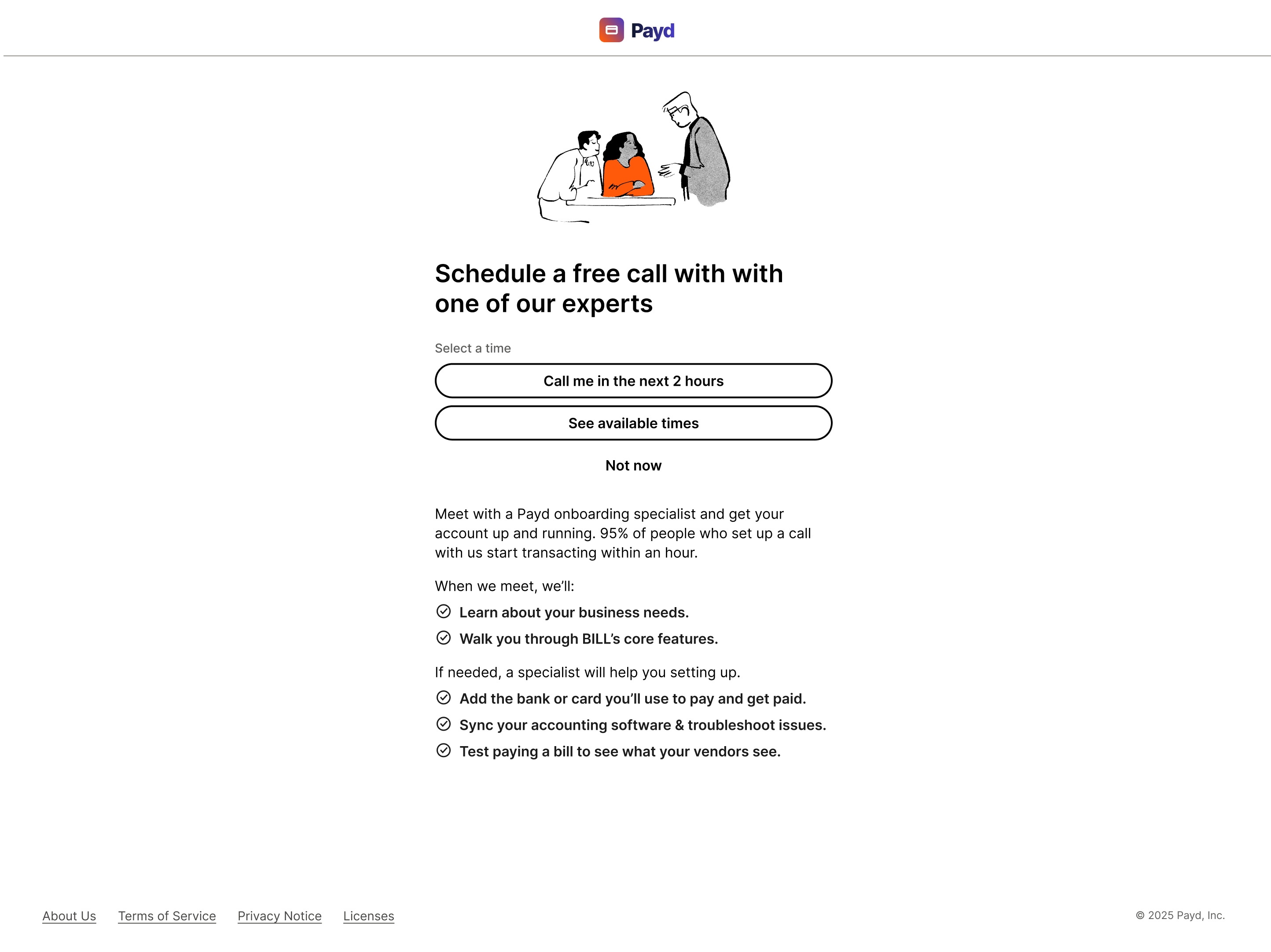
Right then, a curveball came: we learned a critical constraint from the sales team, assigning a human agent to a new lead in the CRM took about 7 minutes through the lead-routing stack. That meant we could not honestly put a working "book now" button in front of a user the moment they signed up, we had to redesign the experience. Instead of designing a simple booking CTA, I designed a three-step flow:
- a signup moment that introduced the value of talking to a product expert.
- a "matching in progress" state on the Get Started page that made the wait visible and understandable.
- a "ready to schedule" state that unlocked the live booking option once routing completed.
I also had to design around how the receiving sales system already worked. If the customer had an assigned rep, the booking needed to land on that person's calendar; if not, it had to route to the concierge team.
The final concept was intentionally direct, it treated human contact as a normal part of getting started. You can see the prototype on top of this page.
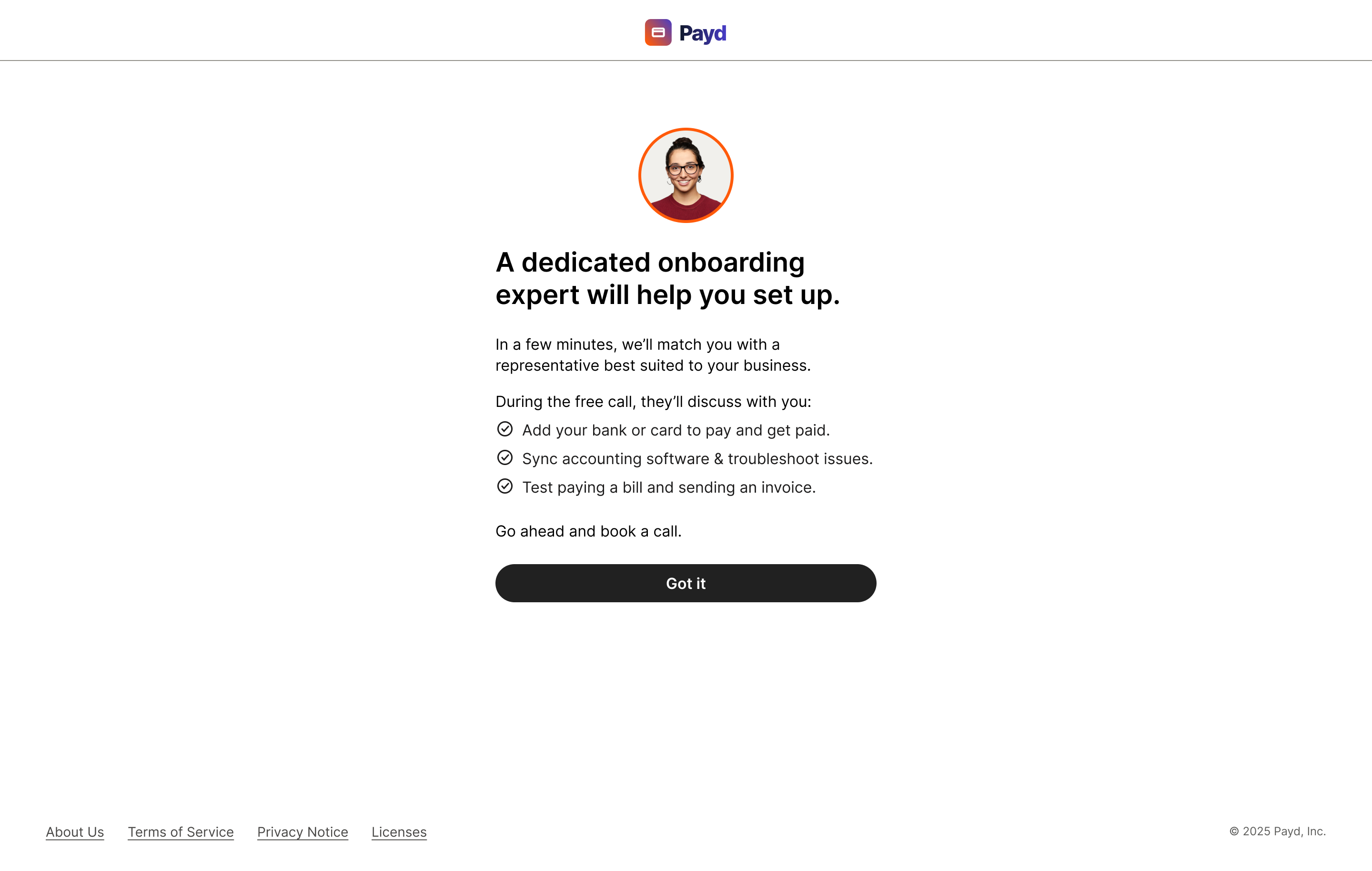
Introducing the value of talking to an implementation expert.
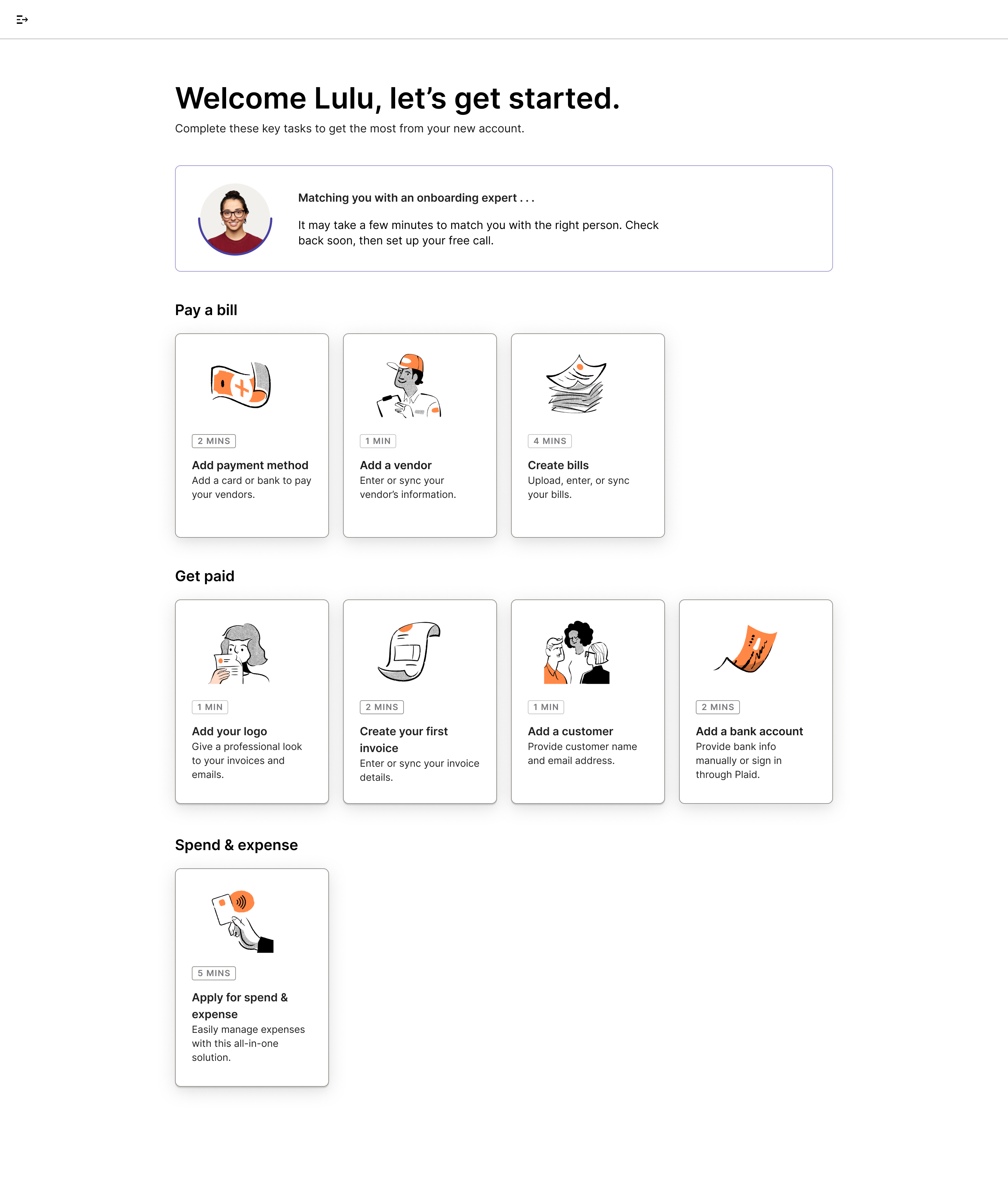
On the Get Started page that made the wait visible and understandable.
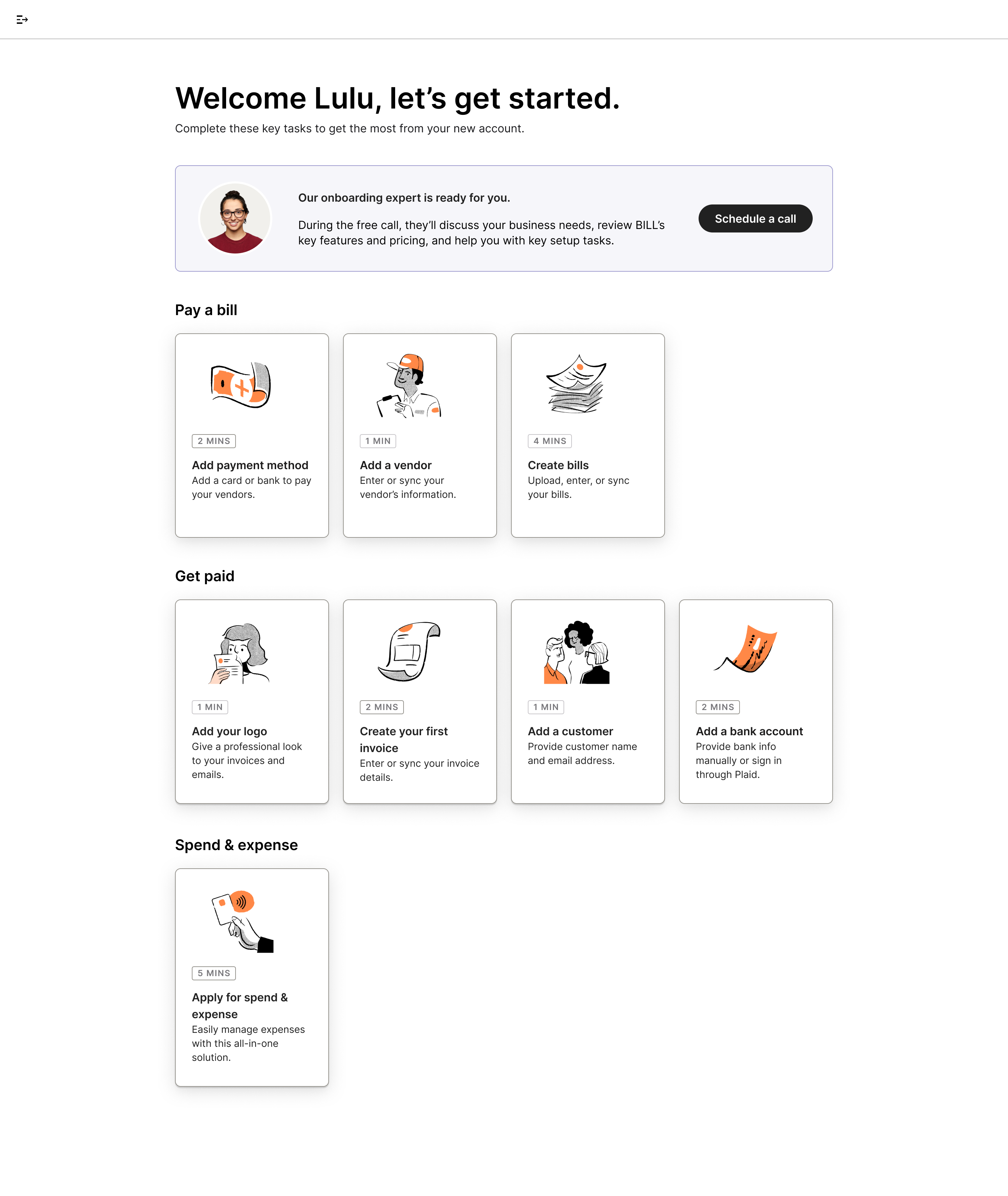
Unlocking the live booking option once customer-to-representatives routing is completed.
04Phased launch & learnings
This feature was designed to be learned into.
The PRD proposed a phased experiment behind a growth feature flag: start with a 50/50 A/B test and an 80% holdout, then reduce the holdout, and eventually widen rollout as confidence increased.
The initial success criteria were basic but important: routing had to work as expected, and the experience could not error out in production. After the team discovered the upstream latency issue we paused rollout. Then we built out the updated design and rollout resumed to 50% before further widening.
The learnings were equally important:
- the value proposition had to be visible enough to register during onboarding.
- the wait had to be explicit and trustworthy.
- the offer needed to appear in more than one meaningful moment, especially on Get Started.
- instrumentation needed to be end-to-end so the team could separate offer exposure, booking intent, availability, booking completion, and downstream conversion.
05Key design decisions & tradeoffs
- Hold user intent across the wait, instead of waiting to surface the offer until the booking link was ready. That meant showing the human-help message in signup, even though the user could not book immediately.
- Be honest about what the system could promise. I chose to design around a truthful promise, that a product expert would be matched and made available, rather than a more persuasive but less reliable one.
- Place the offer in two high-value moments, but not everywhere. We surfaced it in signup and again in Get Started, where returning intent naturally reappears.
- Optimize for self-selection and lead quality, not maximum volume.
- The team explicitly decided not to route the in-product links through the newer workflow because that would introduce risk of misrouted calls. The experience sat alongside existing routing instead of replacing it.
06Outcome & impact
The feature created a booking funnel where none previously existed.
Results: About 5.5% of users who arrive in product now book a call, rising to 7.22% among users who reach the "ready to schedule" state. Roughly 50% of booked calls were attended, and about 25% of customers who completed a call converted their trial. The waiting-state design also proved its worth. 63% of users saw availability within three hours of signing up, and 44% saw more than 100 open slots over the next ten days. The fallback logic proved effective: about 11% of early bookings went to the concierge team rather than an assigned rep, which helped protect the experience from dead ends when routing was incomplete or unavailable.
For a feature designed as a fast Q2 lever, the new experience was creating valuable conversations.
07Reflection & next steps
The biggest lesson from this project was that the constraint became the design. At first, the seven-minute routing delay looked like a blocker. In practice, it forced the team to design a more honest and more resilient experience.
The second lesson was that human help has to feel like help. Customers in self-onboarding are not trying to "talk to sales." They are trying to get their account working. Framing the experience around faster setup and expert guidance, rather than around a sales action, made the interaction feel more natural and more useful.
If I were to continue iterating this design, here are the questions I'd ask:
- How much durable lift does this create in net-new adds and retention compared to Control once the cohort matures?
- Could a more specific callback promise work once the routing system can reliably assign the rep?
- As product-led and AI-assisted onboarding improves, which customers should still be routed to a human by design?